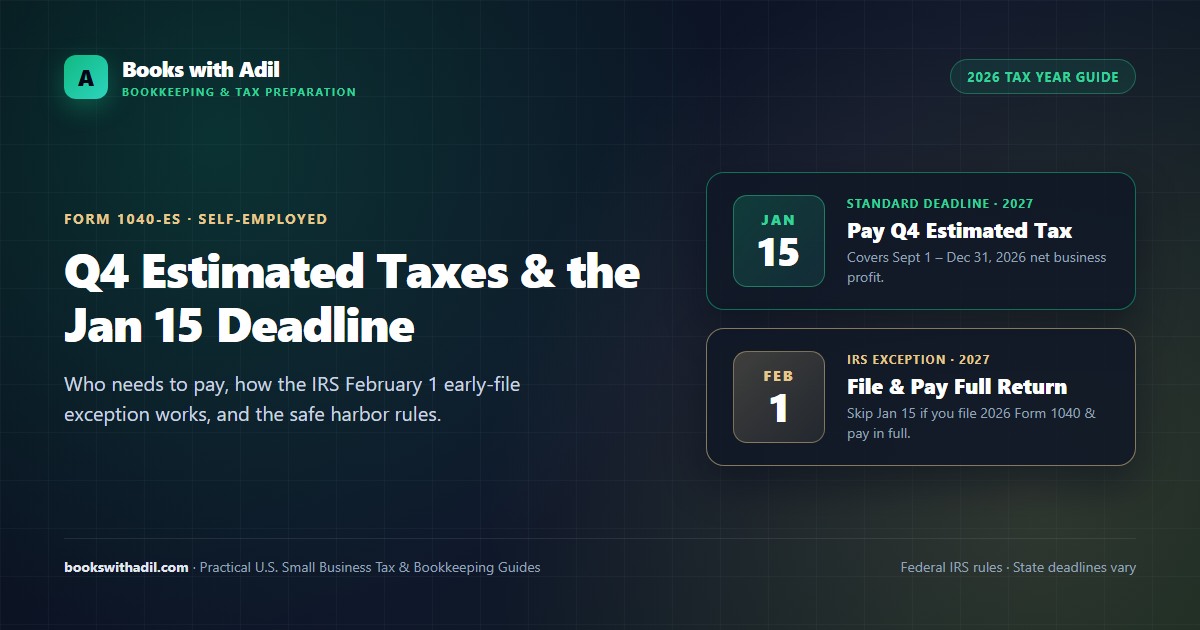
If you are self-employed, a freelancer, a sole proprietor, or a single-member LLC owner, no employer withholds federal income or self-employment taxes from your business income. Because the U.S. tax system is pay-as-you-go, the IRS requires quarterly estimated payments using Form 1040-ES.
If you miss the Q4 deadline, the IRS may assess an underpayment penalty—even if you plan to pay your full balance in April. Below is a clear breakdown of who needs to pay, how the February 1 exception works, and how to calculate and submit your payment without guesswork.
1. Who Needs to Make a Q4 Estimated Tax Payment?
In general, you must make federal estimated tax payments for the 2026 tax year if both of the following apply:
- You expect to owe $1,000 or more in federal tax when you file your 2026 return (after subtracting any W-2 withholding and refundable credits).
- Your total withholding and credits will be less than the IRS safe harbor threshold explained below.
This typically applies to sole proprietors, 1099 independent contractors, freelancers, single-member LLCs filing Schedule C, partners, and S-corporation shareholders with income not covered by W-2 payroll withholding.
2. Why It Matters: What Happens If You Don’t Pay Q4 Estimated Taxes?
Many self-employed owners skip the January 15 payment assuming they can just settle everything in April. Under IRS rules (IRC § 6654), waiting carries four real financial consequences:
The Penalty Uses the IRS Quarterly Underpayment Rate (Compounded Daily)
The IRS underpayment of estimated tax penalty (IRC § 6654, figured on Form 2210) is not a flat fee. It is computed using the IRS underpayment interest rate, compounded daily, for the period an installment is late. Rates are set quarterly and can change. For October–December 2026, the individual underpayment rate was 7% per year, compounded daily. For January–March 2027—which includes the January 15, 2027 Q4 due date—the individual underpayment rate is 8% per year, compounded daily. Confirm the current rate on the IRS quarterly interest rates page and the IRS announcement for the first quarter of 2027.
Penalties Can Apply Even If You Get a Refund
Because the IRS checks estimated taxes quarter by quarter on Form 2210, underpaying during the year can still result in an underpayment penalty—even if you end up getting a tax refund when you file in April.
The April 15 Double Tax Hit
Skipping Q4 does not make the tax disappear. It means on April 15, 2027, you owe your remaining 2026 tax balance AND your 2027 Q1 estimated tax payment on the exact same day.
Guessing Without Clean Books Costs Real Money
Owners who scramble in mid-January with unreconciled bank accounts or missing receipts either underpay (and may owe an underpayment penalty) or overpay because they missed deductions they could have recorded.
3. The IRS Exception: How to Skip the January 15 Payment
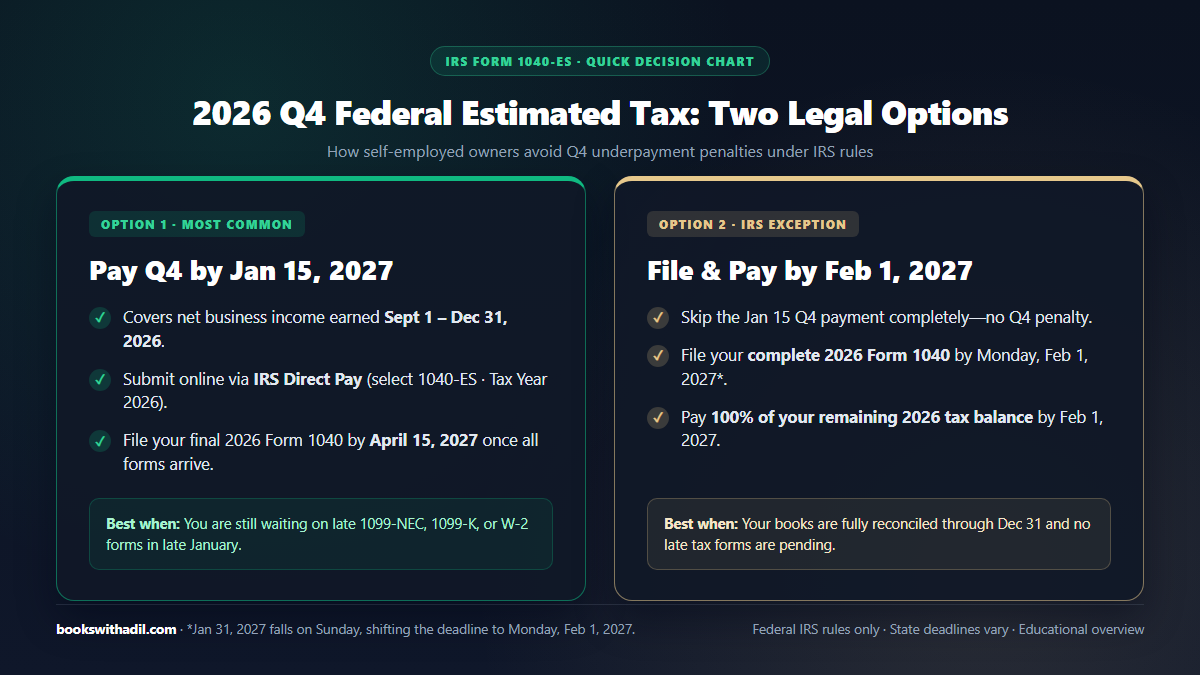
Under IRS instructions for Form 1040-ES and Publication 505, you do not have to make the January 15, 2027 Q4 payment if you meet both conditions:
- You file your complete 2026 federal income tax return (Form 1040 or 1040-SR) by Monday, February 1, 2027 (the statutory date is January 31, which rolls to the next business day because January 31, 2027 falls on a Sunday), AND
- You pay the entire remaining balance due with that return by February 1, 2027.
Should You Pay by Jan 15 or File Early by Feb 1?
For most small-business owners, paying by January 15 is the safer choice:
- Many 1099-NEC, 1099-K, 1099-INT, and W-2 forms do not arrive until late January, making it risky to file a final return before February 1.
- Filing before all tax documents arrive increases the chance of needing an amended return later.
- The February 1 exception works best only if your books are already reconciled through December 31 and you know no late third-party tax forms are pending.
4. How to Avoid Underpayment Penalties (Safe Harbor Rules)
You do not have to predict your 2026 tax bill down to the penny to avoid an IRS underpayment penalty. Under the IRS safe harbor rules, you generally avoid the penalty if your total 2026 withholding and timely estimated payments equal at least one of the following:
| Safe Harbor Option | IRS Requirement (2026 Tax Year) |
|---|---|
| Current-Year Rule | 90% of the total federal tax shown on your 2026 return. |
| Prior-Year Rule (Standard) | 100% of the total tax shown on your 2025 return (if 2025 AGI was $150,000 or less, or $75,000 or less if Married Filing Separately). |
| Prior-Year Rule (Higher Income) | 110% of the total tax shown on your 2025 return (if 2025 AGI was more than $150,000, or more than $75,000 if Married Filing Separately). |
5. How to Calculate Your 2026 Q4 Payment in 3 Steps
Reconcile Through Dec 31
Estimated tax is based on net profit, not gross revenue. Reconcile bank, credit card, and Shopify/Stripe payouts first.
Estimate Total 2026 Tax
Calculate both 15.3% self-employment tax and federal income tax using our free 2026 estimator below.
Subtract Prior Payments
Subtract Q1–Q3 estimated payments and any W-2 federal withholding. The remainder is your Q4 target.
If your QuickBooks Online file is behind or uncategorized, run through our bank reconciliation guide first so you do not overpay taxes on unrecorded expenses.
If you still have room to lower your 2026 bill before December 31, run the numbers on a Solo 401(k) contribution — pre-tax deferrals and the employer share both reduce your taxable income for the year.
6. How to Pay Your Q4 Estimated Tax Online
You do not need to mail a paper Form 1040-ES voucher. The fastest, most verifiable ways to pay the IRS are:
- IRS Direct Pay (irs.gov/payments): Free direct transfer from a checking or savings account—no registration required. Choose Reason: Estimated Tax, Apply Payment To: 1040-ES, and Tax Period: 2026.
- IRS Online Account: View your prior estimated payments and schedule new ones in one dashboard.
- EFTPS (Electronic Federal Tax Payment System): Free U.S. Treasury portal (requires advance enrollment).
Always save your confirmation number and PDF receipt in your 2026 tax folder—you will need the exact payment dates and amounts when filing your 2026 return.
7. Frequently Asked Questions
What happens if I miss the January 15, 2027 Q4 deadline?
The IRS may assess an underpayment penalty calculated on the unpaid amount for the number of days it is late. Paying as soon as possible—even a few days after January 15—stops additional penalty accrual on that portion.
What if I skipped Q1–Q3 payments earlier in 2026?
Making a Q4 payment by January 15 still reduces your unpaid balance and stops further accrual going forward, though it will not erase penalties for missed earlier quarters unless your income was earned unevenly (in which case Form 2210, Schedule AI annualized income method may help).
Does the January 15 payment count as a business deduction?
No. Federal income tax and estimated tax payments are personal tax payments, not deductible business expenses on Schedule C. In QuickBooks Online, record estimated tax payments as Owner’s Draw / Distribution (not an expense) so your Profit & Loss statement stays accurate.