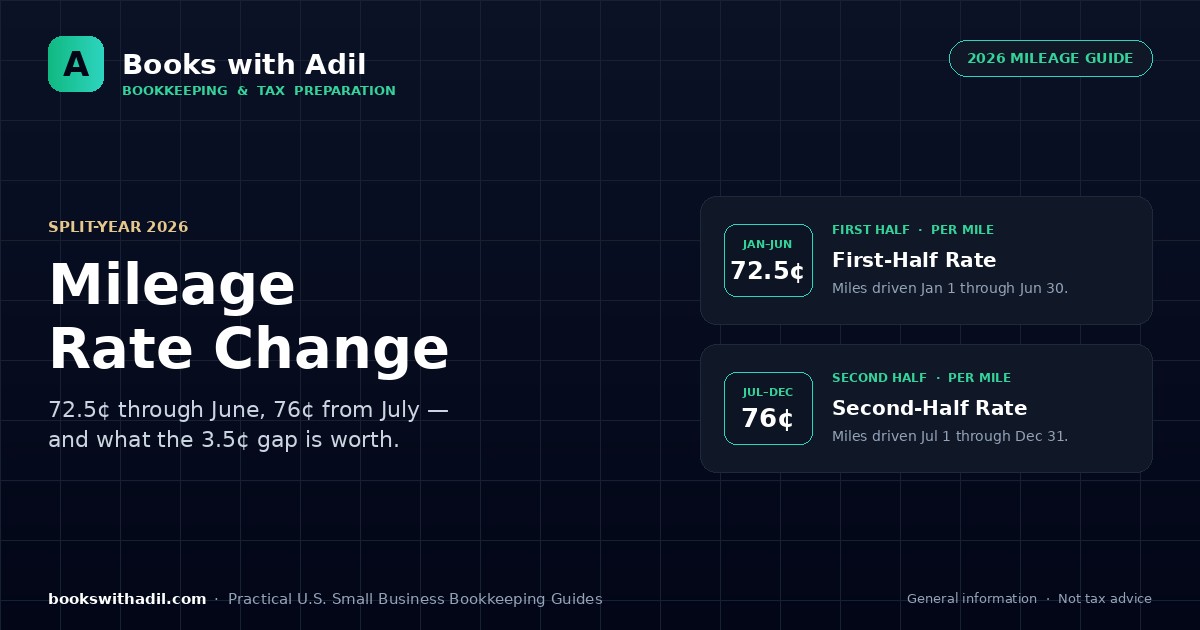
If you drove for business in 2026 and you’re using the standard mileage rate, your miles don’t all count the same. The 2026 IRS standard mileage rate changed in the middle of the year — 72.5 cents a mile for January through June, 76 cents a mile for July through December.
Most mileage guides still quote a single rate for the whole year. For 2026, that’s wrong. A mile you drove in May is worth 72.5 cents. The same mile in December is worth 76 cents. If your log doesn’t split the year in two, your deduction is wrong — usually too low.
This guide shows what changed, how to split your log, and what the 3.5-cent gap is actually worth.
What Changed (and Why)
For 2026, the IRS set the standard mileage rate at 72.5 cents per mile starting January 1 (IR-2025-128). Then, in Announcement 2026-11, the IRS raised it to 76 cents per mile starting July 1.
Mid-year rate changes are rare — the last one was in 2022. The IRS raised the rate because fuel and vehicle costs rose faster than expected during the year. The new rate applies only to miles driven on or after July 1. Miles you drove in the first half of the year stay at 72.5 cents, even though the rate went up later.
That split is the whole story of this guide. Everything else — the log, the math, the comparison with actual expenses — follows from it.
The Math: What the 3.5-Cent Gap Is Worth
The gap is 3.5 cents a mile (76.0 − 72.5). That sounds small until you multiply it by a year of driving:
| Scenario | Jan 1–Jun 30 (72.5¢/mi) | Jul 1–Dec 31 (76¢/mi) | Total / Difference |
|---|---|---|---|
| 10,000 miles (all H1 vs. all H2) | $7,250 (if all H1) | $7,600 (if all H2) | $350 difference |
| 12,000 miles, split evenly (6k / 6k) | $4,350 | $4,560 | $8,910 total |
| 15,000 miles, split evenly (7.5k / 7.5k) | $5,437.50 | $5,700 | $11,137.50 → $11,138 total |
A December mile is worth 3.5 cents more than a May mile. If most of your driving happened in the second half of the year — a busy summer and fall, a late-season contract — the split is worth hundreds of dollars more than a single-rate calculation would give you. And if you used 72.5 cents for the whole year, you underclaimed every July–December mile by 3.5 cents.
How to Split Your Log
The IRS requires a mileage log with the date, destination, business purpose, and miles for each trip. For 2026, the date matters more than usual, because the date decides the rate.
- Step 1 — Split the year at June 30 / July 1. Add up all business miles driven January 1 through June 30. That’s your first-half total, at 72.5 cents. Add up all business miles driven July 1 through December 31. That’s your second-half total, at 76 cents.
- Step 2 — Multiply each half separately. First-half miles × $0.725, plus second-half miles × $0.76. Don’t average the rates and don’t apply one rate to the full year — the average is wrong whenever your miles aren’t split evenly between the halves.
- Step 3 — Keep the two totals visible. On your Schedule C, the vehicle deduction is one line (Line 9), but your records should show the split. If the IRS ever asks, the two subtotals and the two rates are the proof.
- Step 4 — Check it against the estimator. Our 2026 Business Mileage & Vehicle Deduction Estimator applies each rate only to the miles driven in its half of the year. Enter your first-half and second-half miles separately and it does the split math for you — and compares the result against your actual expenses, so you can see which method gives the larger deduction.
If your log is a single year-end total with no dates, you can’t split it. Rebuild it from calendars, invoices, toll records, and fuel receipts before you file — a reconstructed log with dates is far better than a single number with none.
Standard Mileage vs. Actual Expenses in a Split Year
The rate change doesn’t affect the actual-expenses method — your gas, repairs, insurance, and depreciation are what they are, whenever you paid them. It only changes the standard-mileage side of the comparison. That means the split year can flip which method wins.
At the estimator’s defaults — 15,000 miles split evenly, $11,500 in actual expenses at 75% business use — standard mileage gives $11,138 and actual expenses give $8,625. Standard wins by $2,513. But if your actual expenses are high (an older truck, a big repair year) or your miles are low, actual expenses can still win — and the rate change narrows or widens that gap depending on when you drove.
The estimator has an optional breakdown of the 8 IRS actual-expense categories — gas and fuel, repairs and maintenance, tires, insurance, registration and licenses, lease payments, depreciation, and other — so you can see exactly where your actual number comes from. Tolls and parking stay out of that breakdown: they’re deductible on top of either method, so don’t add them to either side.
One rule to know before you choose: in the first year you use a car for business, you can choose either method. For an owned vehicle, if you choose standard mileage first, you can switch to actual expenses in a later year (for a leased vehicle, choosing standard mileage locks you into it for the entire lease). If you choose actual expenses first, you can’t switch to standard mileage for that car later.
Four Mistakes That Cost Money in a Split Year
1. Using one rate for the whole year. The most common error for 2026. Using 72.5 cents for all your miles underclaims every second-half mile. Using 76 cents for all of them overclaims every first-half mile — and overclaiming is the version that draws attention.
2. Averaging the two rates. 74.25 cents (the average of 72.5 and 76) applied to the full year gives the right answer only if your miles split exactly evenly between the halves. If they don’t — and they almost never do — the average is wrong in whichever direction your driving was heavier.
3. Forgetting the log needs dates. A log with destinations and miles but no dates can’t be split, and a deduction you can’t split is a deduction you can’t support. The date is the whole point of the log in 2026.
4. Comparing standard mileage to the wrong actual-expenses number. If you compare the standard rate against your full actual costs without applying your business-use percentage, actual expenses look bigger than they are. Only the business-use share counts — at the estimator’s defaults, that’s 75% of $11,500, or $8,625.
Frequently Asked Questions
Did the IRS mileage rate really change in the middle of 2026?
Yes. The rate was 72.5 cents per mile from January 1 through June 30, 2026 (IR-2025-128), and 76 cents per mile from July 1 through December 31, 2026 (Announcement 2026-11). Mid-year changes are rare — the last one was in 2022.
How do I split my mileage log for 2026?
Total your business miles for January 1 through June 30 and multiply by $0.725, then total July 1 through December 31 and multiply by $0.76. Add the two results. Keep both subtotals in your records — the date decides the rate, so the split is the proof.
What if my log doesn’t have dates?
Rebuild it before you file, from calendars, invoices, toll records, and fuel receipts. A reconstructed log with dates is far better than a single year-end total with none — without dates, you can’t apply the right rate to either half.
Does the rate change affect the actual-expenses method?
No. Your actual expenses are what you paid, whenever you paid them. The change only affects the standard-mileage side — which can flip which method gives you the larger deduction, so it’s worth comparing both for 2026.
Can I deduct tolls and parking on top of the mileage rate?
Yes. Business parking fees and highway tolls are deductible in addition to the standard mileage rate, and in addition to actual expenses. Keep them out of the mileage math and record them separately.
When to Get Help
A split year is simple arithmetic once the log is split — but if your log is a single year-end total, your expenses are mixed with personal driving, or you’re not sure which method wins for your vehicle, that’s bookkeeping work, not a calculator question.
That’s what monthly bookkeeping covers: mileage and vehicle expenses categorized and reconciled every month, so the split is already done when tax season arrives. And if you want to see where the mileage deduction lands on the return itself, our Schedule C guide walks through it line by line.