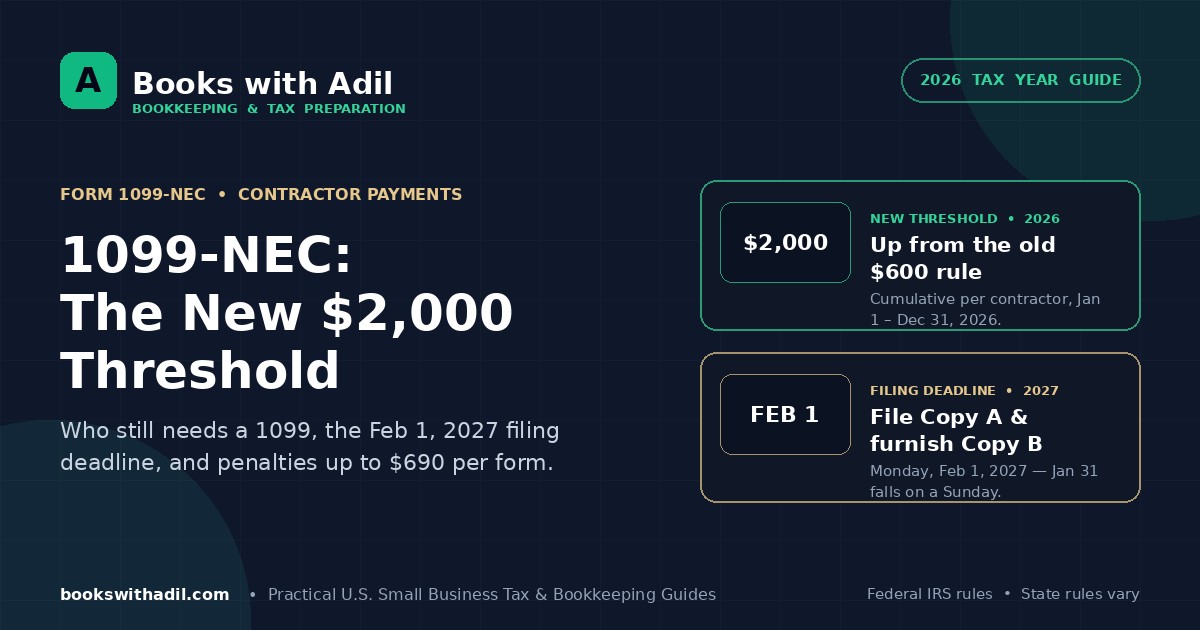
For decades, the $600 reporting rule meant U.S. small-business owners had to track and issue a 1099 for any independent contractor paid $600 or more in a calendar year. (Form 1099-NEC as a standalone form only dates to 2020 — before that, nonemployee compensation was reported in Box 7 of Form 1099-MISC.) For payments made during the 2026 tax year, that reporting threshold increased to $2,000.
While the higher threshold cuts down on paperwork for many businesses, the IRS filing rules and penalties for missing required forms are strict. Below is a clear guide to who still needs a 2026 Form 1099-NEC, what happens if you don’t file, which payment methods are excluded, and how to prep QuickBooks Online before January.
1. Who Must Receive a 2026 Form 1099-NEC?
You generally must issue Form 1099-NEC for the 2026 tax year when all four conditions apply:
- You paid for business services: The payment was made in the course of your trade or business (not personal payments).
- You paid a nonemployee: An independent contractor, freelancer, consultant, subcontractor, or vendor not on W-2 payroll.
- Eligible entity type: An individual, sole proprietor, partnership, or LLC taxed as a sole proprietorship or partnership. (C-Corps and S-Corps are generally exempt, with key exceptions such as attorney/legal services.)
- Cumulative 2026 total reached $2,000 or more: The threshold applies to the total paid from January 1 to December 31, 2026—not per invoice. Four $600 invoices to the same contractor equal $2,400 and require a 1099-NEC.
Two Key Exceptions: (1) If you withheld any federal tax under 24% backup withholding during 2026, you must file Form 1099-NEC regardless of the dollar amount (even under $2,000). (2) For freelancers: earning under $2,000 without a 1099-NEC does not make the income tax-free—you must still report it on Schedule C.
2. Why It Matters: What Happens If You Don’t File Form 1099-NEC?
Many small-business owners treat 1099s as optional paperwork—or wait until March when their tax preparer asks for them. Under IRC § 6721 and § 6722, skipping or filing 2026 Form 1099-NEC late creates four serious financial consequences:
- IRS Penalties Up to $690+ Per Form: For 2026 forms due in 2027, IRS late-filing fines start at $60/form (within 30 days), jump to $130/form (by Aug 1), hit $340/form after Aug 1, and climb to $690+ per form (with no cap) for intentional disregard.
- The “Dual Penalty” Trap: The IRS penalizes late Copy A (to the IRS) and late Copy B (to the contractor) separately. Missing both after August 1 can cost $680 per contractor ($340 × 2)—or $1,380 for intentional disregard.
- The Mandatory 1099 Tax Return Question: Schedule C, Form 1065, and Form 1120-S all ask under penalties of perjury whether you made payments requiring Form 1099 and whether you filed them. Skipping required 1099s puts contractor expense deductions at risk.
- 24% Backup Withholding Exposure: If a contractor refuses to provide a Form W-9 and you pay them anyway without withholding 24% federal backup withholding, the IRS can hold your business liable for the unwithheld tax.
| When You File (2026 Forms Due Feb 1, 2027) | IRS Penalty Per Form (Copy A or Copy B) |
|---|---|
| Up to 30 days late (by March 3, 2027) | $60 per form |
| 31 days late through August 1, 2027 | $130 per form |
| After August 1, 2027, or not filed | $340 per form |
| Intentional disregard | $690 per form (or 10% of reportable amount, whichever is greater) — no annual cap |
3. Payment Methods: Which Payments Count Toward Form 1099-NEC?
One of the most common mistakes small businesses make in QuickBooks Online is double-reporting contractors who were paid by credit card or third-party payment apps.
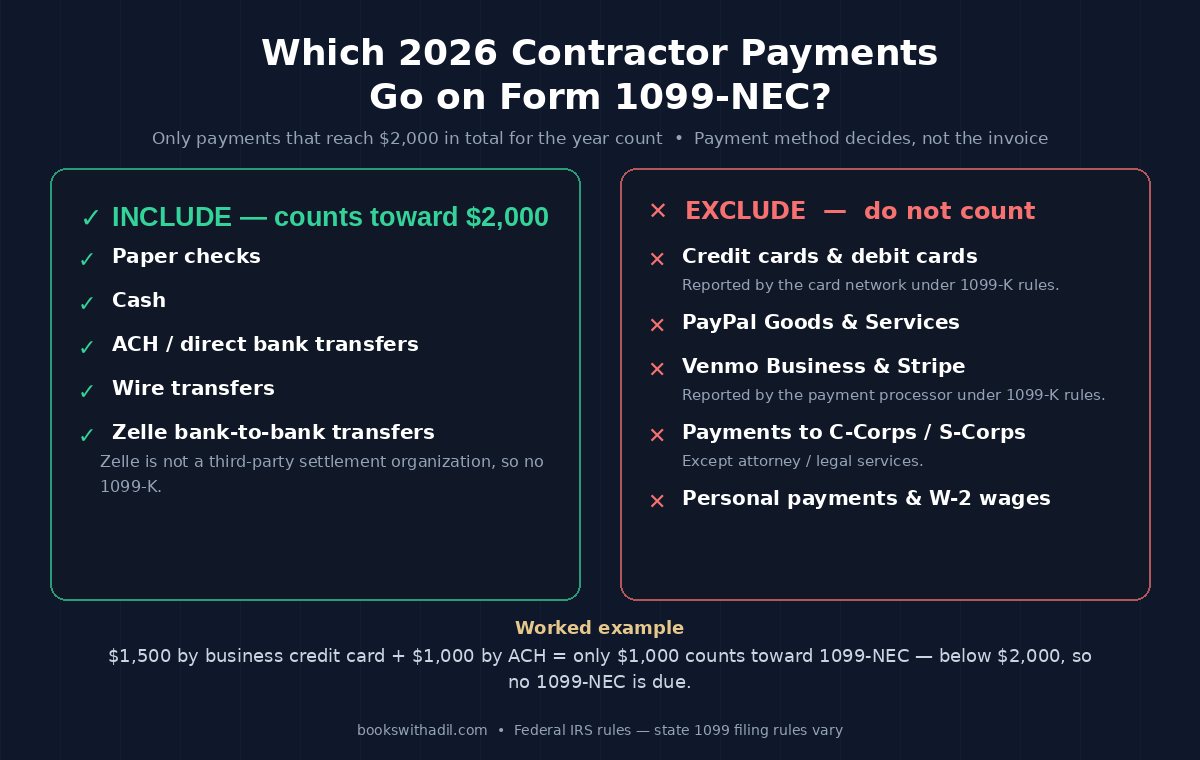
Include on Form 1099-NEC ($2,000+): Paper checks, physical cash, ACH / direct bank transfers, wire transfers, and Zelle bank-to-bank contractor transfers paid to individuals, sole proprietors, partnerships, or single/multi-member LLCs.
Exclude from Form 1099-NEC: Credit cards, debit cards, PayPal Goods & Services, Venmo Business, Stripe (reported by payment processors under Form 1099-K rules), payments to C-Corps or S-Corps (except attorney/legal services), personal payments, and W-2 wages.
Worked Example: Suppose you paid a freelance designer $2,500 in 2026—$1,500 by business credit card and $1,000 by ACH bank transfer. Only the $1,000 ACH payment counts toward Form 1099-NEC. Because $1,000 is below the new $2,000 threshold, you do not need to issue a 1099-NEC for 2026.
4. The 10-Return Electronic Filing Mandate
Under IRS rules, if your business files 10 or more information returns combined for 2026 (adding together all W-2s, 1099-NECs, 1099-MISCs, and other 1099s), you must file electronically. Paper filing once you cross 10 total returns can result in failure-to-file penalties.
You can e-file through the IRS IRIS (Information Returns Intake System) portal (apply early, as obtaining an IRIS Transmitter Control Code takes several weeks) or through QuickBooks Online / approved IRS e-file software.
5. 4-Step 1099 Prep Checklist in QuickBooks Online (Do This in December)
- Collect Missing Form W-9s: Confirm every contractor’s legal name, entity tax classification (Line 3), address, and SSN or EIN before January.
- Check QBO Vendor Settings: In QuickBooks Online (Expenses → Vendors), ensure eligible contractors have Track payments for 1099 enabled.
- Run the 1099 Detail Report: Verify credit card, PayPal, and Stripe payments are properly mapped so they are excluded from Box 1a totals. (The 2026 form renumbered Box 1 to Box 1a for nonemployee compensation, and added Box 1b for cash tips, Box 1c for the tipped occupation code, and Box 1d for overtime compensation.)
- File & Furnish by Feb 1, 2027: Submit Copy A to the IRS, deliver Copy B to contractors, and check your state’s separate 1099-NEC filing rules.
6. 1099-NEC vs 1099-MISC — Which Form for Which Payment?
Form 1099-NEC is only for nonemployee compensation — paying someone for services. Form 1099-MISC covers other business payments: rent, prizes and awards not for services, medical and health care payments, and crop insurance proceeds, among others. Most 1099-MISC boxes also moved to the $2,000 threshold for 2026 payments — but not all of them: royalties stay reportable at $10, and gross proceeds paid to an attorney stay at $600. So a $1,500 rent payment needs no 1099-MISC in 2026, but $10 of royalties still does.
Looking ahead: the $2,000 threshold rises to $2,100 for 2027 payments (Rev. Proc. 2026-35). See the IRS Instructions for Forms 1099-MISC and 1099-NEC for the full rules.
7. Frequently Asked Questions
Does the new $2,000 threshold apply to 2025 or 2026 payments?
The $2,000 Form 1099-NEC threshold applies to payments made during calendar year 2026 (due February 1, 2027). The prior $600 threshold applied to 2025 payments filed in early 2026.
Do I need to send a 1099-NEC to an LLC?
It depends on how the LLC is taxed—shown on Line 3 of their Form W-9. Single-member LLCs (disregarded entities) and multi-member LLCs taxed as partnerships do require a 1099-NEC at $2,000+. LLCs taxed as a C-Corporation or S-Corporation are generally exempt (except for attorney/legal services).
What if a contractor refuses to give me a Form W-9?
Document your requests (keep written proof) and begin 24% federal backup withholding on any further reportable payments until they provide a valid TIN. Report the withheld tax in Box 4 of Form 1099-NEC.
What if I’m a contractor who made $1,500 and didn’t get a 1099-NEC?
You must still report all business income on Schedule C and plan for self-employment and Q4 estimated taxes.
Can I get an extension on the 1099-NEC deadline?
Not automatically. Unlike other 1099 forms, Form 1099-NEC does not qualify for an automatic extension. You can only request a one-time, non-automatic 30-day extension on paper using Form 8809 (filed by February 1, 2027) if you meet one of the IRS’s strict hardship criteria—such as a federally declared disaster, fire/casualty, serious illness or death of the responsible filer, or your first year in business. Even if approved, Form 8809 only extends Copy A to the IRS; it does not extend the February 1 deadline to furnish Copy B to contractors.
What’s the difference between Form 1099-NEC and Form 1099-MISC?
Form 1099-NEC reports pay for services by a nonemployee. Form 1099-MISC reports other business payments such as rent, royalties, prizes, medical payments, and gross proceeds paid to an attorney. Most 1099-MISC categories also use the $2,000 threshold for 2026, except royalties ($10) and attorney gross proceeds ($600).