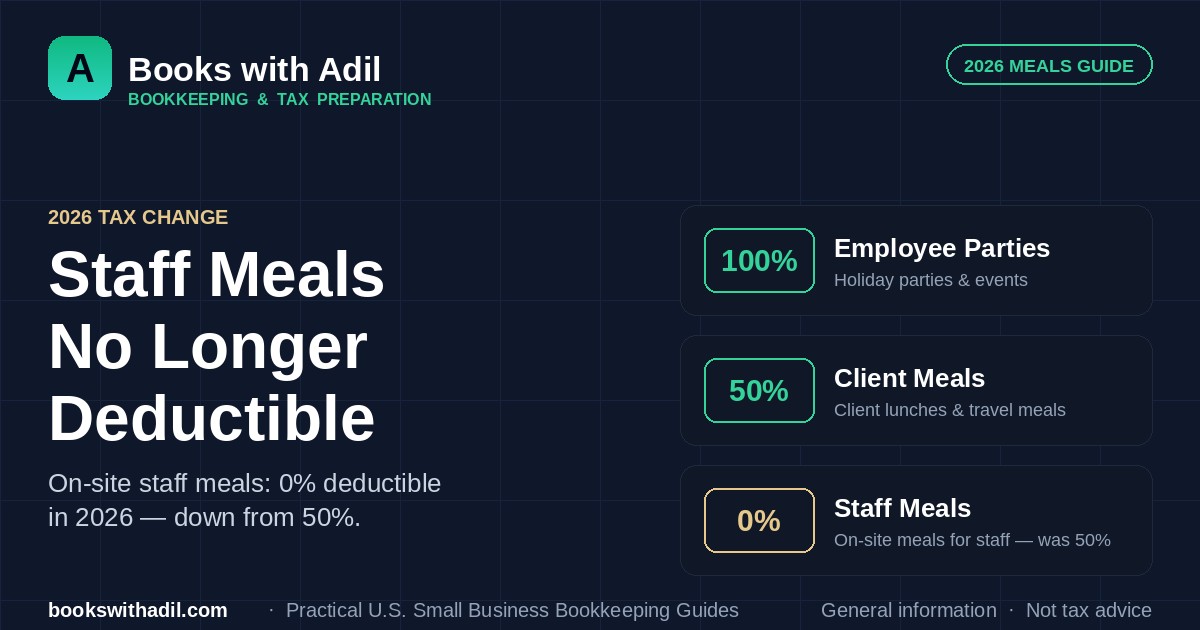
If you feed your staff on site — catered lunches, a stocked kitchen, dinner during a late shift — the tax treatment changed on January 1, 2026. Through 2025, those meals were 50% deductible. From 2026, they are 0% deductible. The deduction is gone, not reduced.
This is a rule written in 2017 that took effect in 2026, and a lot of business owners haven’t heard about it yet. If your books still treat staff meals the way they did last year, your 2026 return will overclaim — and the overclaim is the kind of thing that shows up in an audit, not the kind that fixes itself.
This guide shows what changed, which meals still count, the one big exception, and how to split your books so the 2026 return is right.
What Changed (and Why)
The Tax Cuts and Jobs Act of 2017 included a delayed change in Section 274(o) of the tax code. From 2018 through 2025, meals an employer provided for its own convenience — keeping staff on site during a busy shift, feeding a crew that can’t leave the premises — were 50% deductible, like other business meals. Section 274(o) said that treatment would end for amounts paid or incurred after December 31, 2025.
That date has now arrived. Starting January 1, 2026, no deduction is allowed for:
- Meals provided for the convenience of the employer (Section 119(a)) — meals furnished on your premises because employees need to stay available during a shift, an emergency, or a short meal break.
- An employer-operated eating facility (Section 132(e)(2)) — a cafeteria or similar program you run, including the food and beverages and the cost of operating it: staffing, third-party food-service contracts, and related expenses.
The One Big Beautiful Bill Act added a few narrow exceptions (see below), but for most employers the rule is simple: staff meals on site went from 50% to 0%.
One thing that did not change: the employee’s side. Under Section 119, employees can still exclude the value of these meals from their income — no FICA, no income tax withholding, no W-2 inclusion. The meal is still tax-free to the employee. It is the employer’s deduction that disappeared, so the employer now pays the full cost out of after-tax dollars.
The 100 / 50 / 0 Table for 2026
| Meal | 2026 federal deduction |
|---|---|
| Holiday party or picnic, primarily for employees who are not highly compensated | 100% |
| Meals treated as taxable compensation and reported as wages | 100% |
| Meals sold to employees or customers at full value | 100% |
| Meals provided to food-service employees by a restaurant that sells food to customers | 100% |
| Meal with a client or prospect, business discussed, you or an employee present, not lavish | 50% |
| Meals while traveling away from home on business overnight | 50% |
| Business meeting meals (conventions, luncheons, trade shows) | 50% |
| Meals at an employer-operated cafeteria or eating facility | 0% |
| Meals furnished for the employer’s convenience on premises | 0% |
| Catered on-site staff lunches or late-shift crew meals | 0% |
The short version: client and travel meals (50%), employee parties and meals reported as wages (100%), on-premises staff meals (0% unless an exception applies).
The Math: What the Change Is Worth
Take a business that spends $500 a month on staff lunches — $6,000 for the year:
- 2025: 50% deductible, so a $3,000 deduction. At a 22% marginal rate, that’s $660 of tax benefit.
- 2026: 0% deductible, so a $0 deduction. The same $6,000 of lunches, and the $660 is gone.
Now a mixed year — a business that spent $12,000 on meals in 2026:
| What was spent | Amount | 2026 deduction |
|---|---|---|
| Staff meals on site | $6,000 | $0 (0%) |
| Client meals | $4,000 | $2,000 (50%) |
| Holiday party for staff | $2,000 | $2,000 (100%) |
| Total | $12,000 | $4,000 |
Four thousand dollars deductible out of twelve thousand spent — and only because the three kinds of meals were tracked separately. If all $12,000 sat in one “meals” account and someone applied the old 50% to the whole thing, the return would claim $6,000: a $2,000 overclaim.
The Restaurant Exception
There is one big exception, and it matters to a lot of the businesses reading this site. The One Big Beautiful Bill Act preserved the deduction for meals sold in a bona fide transaction for adequate and full consideration — which covers a restaurant or catering business that sells food and beverages to customers and also provides meals to its employees. The regulations allow restaurants to deduct 100% of the cost of meals provided to food-service employees before, during, or after their shifts.
So if you run a restaurant, your staff meals are generally still deductible. If you run a contracting company, an HVAC shop, or an e-commerce business and you buy lunch for your crew, they are not — the exception is for businesses that sell food, not businesses that buy it.
The Bookkeeping Fix: Split Your Meal Accounts for 2026
This is a bookkeeping change before it is a tax-return change. If your chart of accounts has one “Meals” account, 2026 is the year to split it — at a minimum:
- Business & Client Meals — 50% Deductible (client lunches, travel meals, meeting meals)
- Employee Meals — On-Site Convenience — Non-Deductible (staff lunches, shift meals, cafeteria costs)
- Employee Events — 100% Deductible (holiday party, company picnic)
Deductible business meals land on Schedule C, Line 24b. The non-deductible half doesn’t go on the return at all — it stays in the books as an expense, just not a deductible one. That distinction is exactly what a single lumped account hides, and it’s why this is a year-end closing item, not something to sort out in April.
The Gray Area: Breakroom Coffee and Snacks
One honest caveat. The treatment of small breakroom items — coffee, water, snacks — is the one place the big firms disagree. BDO’s guidance says most employers’ breakroom and kitchen drinks and snacks are still 50% deductible, because they are de minimis fringe benefits rather than Section 119 meals or an eating facility. Other firms list coffee, beverages, and snacks as nondeductible under the new rule.
We are not picking a side for you here, because the guidance genuinely splits. What we can say: segregate those costs in their own account, keep the receipts, and ask your preparer before you file — don’t lump them in with clearly deductible client meals, and don’t write them off as clearly nondeductible either. If the IRS clarifies the point, a separate account is what lets you fix it in one entry instead of rebuilding the year.
Four Mistakes That Cost Money in 2026
1. One account for all meals. The most common error for 2026, and the one that causes all the others. If staff meals, client meals, and the holiday party share one account, the return either overclaims (old 50% applied to everything) or underclaims (the whole account treated as nondeductible). Split the accounts and the return writes itself.
2. Claiming 50% on staff meals. The 50% rate for on-site staff meals ended December 31, 2025. Claiming it in 2026 is claiming a deduction the law no longer allows — and it is the exact line an examiner would check first, because the change is public and the date is fixed.
3. Assuming the restaurant exception applies to you. It applies to businesses that sell food to customers. Buying lunch for your crew does not make you a restaurant. If you don’t sell food, the exception doesn’t cover you.
4. Thinking the change hits your employees’ pay. It doesn’t. The meals are still excluded from your employees’ income under Section 119, with no FICA or withholding. Nothing changes on their paychecks or their W-2s — only on your deduction.
Frequently Asked Questions
Are staff meals deductible in 2026?
No. Meals provided on your premises for your convenience, and meals from an employer-operated cafeteria, are 0% deductible for amounts paid after December 31, 2025 (Section 274(o)). They were 50% deductible through 2025.
What about coffee and snacks in the breakroom?
That is the one area where the guidance splits. BDO says most breakroom drinks and snacks are still 50% deductible as de minimis fringe benefits; other firms treat them as nondeductible. Segregate them in their own account and confirm with your preparer before you file — don't lump them with client meals.
Do restaurants still deduct staff meals?
Yes, generally. A restaurant or caterer that sells food to customers in bona fide transactions falls under the Section 274(e)(8) exception preserved by the One Big Beautiful Bill Act, and the regulations allow 100% for meals provided to food-service employees before, during, or after shifts.
Are client lunches still 50% deductible?
Yes. Meals with a client or prospect — business discussed, you or an employee present, not lavish — stay 50% deductible, as do meals while traveling away from home on business overnight.
Do I need to change my books for this?
Yes. Split your meal accounts in 2026 into 50%-deductible, 100%-deductible, and non-deductible buckets. The deductible portion lands on Schedule C, Line 24b; the non-deductible portion stays out of the return. One lumped account is how the overclaim happens.
When to Get Help
Splitting three meal accounts is ten minutes of bookkeeping if your books are clean — and a reconstruction project if they aren’t. If your 2026 meals are sitting in one account, mixed with personal spending, or scattered across cards, that’s the work to do before year-end, not in April.
That’s what monthly bookkeeping covers: meals categorized by deductibility every month, so the split is already done when tax season arrives. And if you want to see where the deductible meals land on the return itself, our Schedule C guide walks through it line by line — deductible meals are Line 24b. And when the year closes, federal and state tax return preparation puts the split on the return itself.